-
The “Grant Team”
Back when I was at Federation University, 2020, they offered a Cross-School Grant (internal). It was up to $10,000 for a research team with at least one Early Career Researcher (ECR) and at least one person from Education, Arts and Business. I originally had the idea to evaluate a new program where the Learning Skills Advisors (LSAs) spend 5 minutes visiting classes on campus in the School of Business. We were going to trial it in Arts and Education as well. But then the pandemic hit and on campus classes were all cancelled.
I did however speak to a librarian who suggested I talk to an amazing woman named Ellen Sabo who was a project manager in the department that looked after student support services. Ellen was my boss back when I was an undergraduate and working as a student mentor. Great lady! Anyway Ellen had run these “boot camps” before orientation specifically to help students study online, as they all had to do because of the pandemic. There was also a booklet of information for students studying online (paper copy) that was mailed to students that requested it. So instead I decided to evaluate these initiatives and Ellen was the first one on board.
Then I reached out to Bryce Magnuson from Marketing/economics (in other words the mandatory Business academic). I didn’t know him that well but we had had a number of corridor conversations about first year students and how to support them. I knew he cared deeply for his students and he signed up as well. Next was David Waldron from Arts who is the most passionate, animated History academic I have ever met. Again, I didn’t know him that well but I knew he was passionate about helping new students. So I thought this would be the team and we got started.
We soon learnt that as I was only a sessional (casual) I could not be on the grant (again!) I could only be a research assistant and I did not count as the academic from the school of Education. At that point Anna Fletcher joined us to cover the school of Education. The 5 of us are the “grant team” and we got that grant, $8000. Bryce officially became the project lead, although everyone knew it was my project and I continued to do a lot of the organisation, setting meetings and so on. Mostly I was the driver, the motivator, the glue of the team and Bryce made the final call on all decisions and was the name on the paperwork.
That is not to say that he didn’t have a major contribution. In fact he really stepped up the moment he was officially the project lead. In 2020 data was gathered and analysed.
2021 there was a special edition for the Journal of University Learning and Teaching Practice (if that sounds familiar, this is a separate special issue, same journal!). Our abstract was accepted but the suggestion was made that we combine our data with a Michelle Joubert from the University of the Free State, South Africa! Well a neon sign saying “International collaboration” flashed before my eyes and that was all the convincing we needed!
I think the challenges of international collaboration are worthy of an entire blog post all of their own, so this time around I will simply say, there were many challenges! One significant one was that Ellen had some serious personal issues and she disappeared for a couple of months with no contact! She did however swoop back in and save the day a couple of weeks before the full article had to be submitted. She did some very excellent work editing our draft that was over the word limit.
The special edition is meant to come out this August I think, could be September! We have not yet heard back from the reviewers, so that timeline should be rather tight we expect! Stay tuned for more information on that one!
The only other thing of note here is that Michelle and I are likely to be working together on another project. This time Karen Seary (my Dean, or perhaps her title is Associate Dean?) is on board and another co-worker here at CQU. We plan to look at student preparedness and compare Australian enabling students with South African students in the equivalent sort of program over there. Haven’t really had our first proper meeting about it yet… once again, stay tuned!

-
Rural placement for Pre-Service Teachers (PST’s)

This is a stock image from Microsoft Office This is probably one of the last “story so far” posts I will do around research projects, but this one should not be excluded! I think tomorrow or over the weekend I might attempt to talk about my PhD! Yikes! This project is somewhat of a long story though, and I’m fuzzy on some of the details.
Every year the National Centre for Student Equity in Higher Education (NCSEHE) offered grants for various projects the will improve equity. Either their website hasn’t been updated or the grants ceased in 2021, unsure! Anyway, in either 2019 or 2020 they had specific themes and I noted that a project around enabling students would be really appropriate. I was still at FedUni but as I had been consistently searching for more stable/ongoing work I had a contact at Monash University, Kirsten Reimer and (again from job seeking efforts) Ann-Marie Priest at CQU. So I contacted them and before I knew it I had a little team of people interested in a multi-university grant application.
We had 3 or 4 meetings to discuss it and surprisingly found we were all on the same page! At that point I invited my supervisor to join. We ended up with a team of 9 academics and an unsuccessful grant application. I was not too disappointed when we didn’t get the grant because I had expanded my professional network and learnt a LOT about the grant application process. That was the highlight. The “lowlight” was when I was told that as I was only a sessional (casual) staff member I could not have my name on the grant application. However, if we had got the grant I would have been employed as a Research Assistant (RA) so I could have put that on my resume instead of “grant recipient”.
Dr. Tim Fish was one of the Monash academics on that grant team and almost as soon as we knew we did not get the grant I contacted Tim and asked if he would work with me on another project because we were both passionate about regional and remote students. Well that was the beginning of something I never could have predicted!
He was part of a team with Richard O’Donnovan and Ondine Bradbury. In fact, they had already got ethics approval and were just about to start interviewing students! I was well and truly late to the party! But I was keen and had plenty of spare time. I also told Tim straight up that I was happy to be last author on anything and everything because I really just wanted to learn and be part of the research process.
So with Tim’s guidance I conducted some of the interviews and did my share of transcribing as well. We had students from Monash and Deakin that had done their teacher placements in rural locations. We have divided them into 3 groups, rural students doing rural placements in Victoria, metropolitan students doing rural placements in Victoria and students that went to the Northern Territory to do a rural placement. The NT group were quite different as they went interstate and also experienced much higher rates of Indigenous students. So we asked them all about their experience of a rural placement, their motivations and of course if they intended to work in a rural location when they graduated.
Cutting a long story short, the rural students wanted to stay in rural schools when they graduated. The metropolitan students were not against the idea of teaching in a rural school but it was usually considered something for later in their careers. I’m not convinced that many of the metropolitan students really understood what it is like to live and work in a rural environment. It’s not just cows looking over you, yes I am referring to the image! Government have put a lot of funding and incentives out there, attempting to lure teachers to rural areas that are hard to staff. But our findings certainly suggest that they would be better to take the rural population and offer them local opportunities to study education because it is likely that they will stay and teach in their rural location once they graduate.
This project sort of snowballed when Richard gained access to some data from the Department of Education. So we have one article submitted and awaiting review at the moment. Then another 3 planned!!! All at various stages of completion! A little crazy I guess but this hasn’t happened in 5 minutes, it has been well over a year. We have fortnightly meetings that are always a laugh, such a great team.
-
Stop the clocks!

Stock Image from Microsoft Office We had an article submitted yesterday titled “Stop the Clocks: Enabling Practitioners and Precarity in Pandemic Time(s).” Obviously it still needs to go through the review process, but a submission is still an achievement. When I say “we” it is a team of academics that has come together through the Mental Health Special Interest Group (SIG) as part of NAEEA (National Association of Enabling Educators Australia). The team includes the amazing Anita Olds, Angela Jones, Joanne Lisciandro, Susan Hopkins, Juliette Subramaniam, Helen Scobie, Marguerite Westacott and Rebekah Sturniolo-Baker. All very amazing, driven and intelligent women. I’m not sure how long we have been working on the project to be honest, but I have emails that go back to mid-2021. The entire experience has been extremely positive.
So the paper is an autoethnography where we each wrote a reflection about what it was like to be an enabling educator during 2020 when the pandemic hit. For me, I lost my sessional work and had to relocate from Victoria to Queensland just to remain employed so that was kind of a big deal! My job up here is 0.5 and many people think it’s really crazy to move across the country for a job that is not even full time. However I am a PhD student, so I’m not quite ready for full time work, but, more to the point, this position had two magic words – permanent, ongoing!
We had 8 written reflections that we then thematically analysed and discussed in this paper. I think the image above reflects the interconnectedness we discovered despite all our journeys being different, many common themes. It is not a full on feminist paper but those themes are there. Mostly we talk about neoliberalism, guilt and shame and the uncertainty that we all experienced.
I have no doubt that some, if not all of us involved in this project will work together again. It’s just a matter of when that will happen. In fact I’ve already pitched another autoethnography idea to Anita, the first author. That one will certainly wait until after my confirmation is done. Susan Hopkins and I also have plans to write a discussion piece together. In fact I had around 3000 words of a draft that I took to her. She instantly agreed I had a good idea and that the paper should get finished and published. I just call it the “Intersectionality piece”. Basically I argue that in higher education research everyone adds a disclaimer to their work that basically says “yes we know that many of these students belong to more than one equity group, but it is beyond the scope of this project to investigate that any further.” I hate that!
I can agree that intersectionality as a method is a little fuzzy and many researchers may not have the confidence or skills to use it. But if intersectionality is thought of more as a framework, a philosophy or a discourse that guides the research then it is not that difficult to include and add to discussions! I guess it is a pet peeve of mine because I know how each part of life affects other things. My diabetes, for example, can affect absolutely everything at times and if I lived in a major city those affects would be very different. But I live in a rural town and although I have relocated I have been in rural locations for at least the last 20 years. The intersection of a low income, chronic illness and rurality is very real in my life.
Anyway, the intersectionality article is on hold at the moment with the goal of submitting it before the end of the year. I still have 7 assignments to mark so I should attend to that!
-
TAFE project
I mentioned the TAFE project with Dr. Susan Emmett (Sue) in my last post so I thought I would give the full story now. Sue and a number of FedUni academics did a small survey in 2016 of students that had come from TAFE and entered FedUni with at least one unit credited. They presented their findings at a conference but never published a journal article from it. So they have all this data that is just sort of sitting there. Essentially it’s asking students that went into second year university from TAFE if they feel disadvantaged because they missed all the support services which are aimed at first year students. There was mixed results. Most had faith in the practical skills and saw it as an advantage but struggled with the nature of independent learning at university.
Sue told me about it sometime in 2020, after we were well underway with our first article. She asked me if I wanted to come on board with the rest of the team and get that article published. I wanted to finish our current article first (and that turned into multiple publications so it’s still not quite “finished” in that sense). We also talked about how the data was 4 years old and would probably be 6 or 7 years old by the time we were actually published.
One thing I should add here is how it all made me feel. I didn’t even have 1 publication yet. Just finished Honours, no Masters, nor PhD. When Sue asked me to join this project it said a thousand things at once. It told me she had faith in my abilities, including research and writing, that she enjoyed working with me, that she wanted to work with me again on a longer term project… you get the picture. It was a huge compliment and it felt great! Of course that meant I couldn’t say no, but the topic interested me so that wasn’t an issue.
Sue and I decided to treat the original project as a pilot and do an expanded repeat of it with students from both FedUni and CQU. We contacted the original team and only Talia Barrett had the capacity to join us. So now that is the team, Sue, Talia and I. It has been lovely to get to know Talia as well. She is not a teaching academic, she works in the department that provides all the student support services; mentors, PASS sessions and so on.
We updated the survey questions and turned the project into mixed-methods with follow-up focus groups after the initial survey. We could copy some of the ethics application from the original project, which we knew had passed ethics, so that saved us some time. Still it has taken over a year to get to this point – ethics has just been approved at FedUni.
Next on the to-do list is to copy and paste those details across into the CQU ethics. I’ve had to contact our ethics people to add Sue and Talia in the system. So data collection at FedUni should start next semester which is rather exciting. I will be conducting the focus groups from FedUni and they will do the ones from CQU – all online of course.
The other significant thing that has happened in this project is the development of a framework that we intend to use to structure our discussion section. Ella Kahu has published multiple articles on and around a Student Engagement Framework (SEF) which beautifully brings together student factors like attitude, self-efficacy, motivation, then socio-cultural factors, institutional factors and so on.
In the more recent works Kahu talks about the educational interface – the place where the student meets the university. This is essentially the area we are exploring in our study. So I suggested we use the SEF. Then a few weeks later I read a couple of articles by Eugenia Katartzi and Geoff Hayward. They have a framework specific to TAFE students which brings together Bourdieu (who I’m quite familiar with) and Bernstein (who I’m less familiar with). They talk a lot of the power relations and how “TAFE knowledge” may be considered less than “university knowledge”. When I read about it, it was clear that their entire framework would fit nicely within the educational interface that Kahu proposed.
Talia and Sue loved it – so I was happy. But still I felt the need to ask Kahu herself what she thought (before I modified her amazing framework). I contacted her via email and explained my idea as well as attaching the articles from Katartzi and Hayward. She thought it was an excellent match up and essentially gave us the go ahead. It was another huge compliment, one I’ll never forget. On that very positive note, I should end this post. I have marking to do!
-
First publication
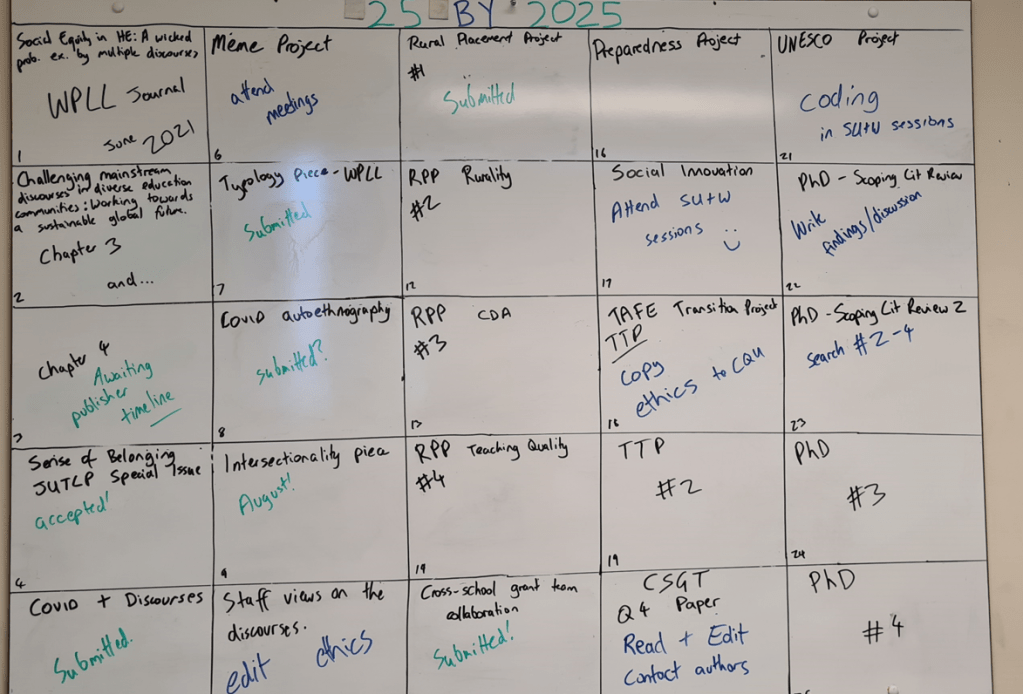
Whiteboard updated with the fourth publication as accepted Last post I explained my latest publication, number 4! Now I’m going to talk about my first one. The idea came out of my honours thesis. I looked at the Department of Education’s statistics for Low Socio-Economic Status (LSES) and regional or remote students at 6 regional universities. I talked about enrolment rates, success rates and retention rates. But in the process I couldn’t avoid reading a lot around neoliberalism, social justice and widening participation and how at time neoliberalism clashed with social justice values.
I found one UK article which beautifully divided the different viewpoints, calling them philosophies. Then I found another article that did something similar, but with different terminology and then another article again! So I blended these 3 articles and defined 3 different discourses on social equity in higher education. Then I applied these discourses to the statistics to show that the “success” of the universities in widening participation really does depend on one’s point of view.
My supervisor talked about writing an article from my honours thesis about how the multiple ways that we measure LSES and rurality complicates things. I suggested we do something on the discourses as well and he agreed. Sadly he had about 12 staff and an enabling program to manage and never found the time to write it with me. He was encouraging of research and publication, just not as much with the sessional staff like me that did not have output targets in our workload. So after about a year, and many mentions of the article to him I gave up.
I was moved from one campus to another and got to know more of the staff in the School of Education. Their offices were all lined up down one corridor. So I started at one and and knocked on doors! Well just door really because Dr. Sue Emmett was the first one and I didn’t have to go any further. I told her I had the concept for the article and I’d already done most of the reading I needed to. I just needed to write it and have someone help me edit it and get it up to publication standard (and I didn’t really know where that bar was). Of course I also needed help with the whole publication process too.
Sue is the sort of person who loves helping others and she is not competitive at all, she wants everyone to succeed. We had some very excellent conversations as we slowly put together a discussion piece. More reading was done and the original 3 discourses was broken into 4; neoliberalsim (economist), transformative (human potential), social justice and meritocracy.
So we started writing in about October 2019, just after my mother passed away, and submitted a 2000 word discussion piece to the journal of Widening Participation and Lifelong Learning in May 2020. I could write a 2000 word essay in 3 days but apparently it takes longer when it’s for a journal!

Timeline of publication with WPLL journal Of course in that time the Covid-19 pandemic hit the world. Sue, very wisely pondered how the pandemic might affect the discourses we had defined. Before I knew it our one discussion piece had turned into 3 journal articles and a book chapter! The second article focuses on the pandemic and the discourses. It’s the 5th publication on the whiteboard, submitted. We have also submitted another discussion piece which names the 4 discourses as a typology and discusses why that is useful in more detail. The book chapter came through what they call a Research Focus Area in the School of Education at FedUni. It’s called SJIDE (sa-jyde- E) Social Justice, Inclusion and Diversity in Education.
Anyway SJIDE were putting together an edited book so Sue and I put in a chapter which goes over the discourses again and talks a bit about the pandemic as well. That is publication #2 on the whiteboard, just waiting for the timeline from Springer!
There is one more planned publication with Sue and that is a content analysis of the latest UNESCO report to see if we can identify one or more of our discourses. We are chipping away at this in weekly sessions. Stay tuned for more information on that one (in the top right of the whiteboard).
Somewhere in this whole process Sue asked me to be a part of a TAFE project too… but that’s going to be a whole separate post!
-
Whiteboard update!
Well it seems I need to update my whiteboard because the discussion piece that I wrote with Trixie James has officially, as of yesterday, been accepted. That is my 4th publication and my 2nd journal article so I am still rather excited. Yesterday was a day filled with good news.
I had a conversation with George Lambrinidis who is a very experienced enabling educator and he paid me a giant compliment. He told me I should be more confident in what I know and my abilities then went on to say that I was a leader and if I wasn’t already a leader in my field that it was just a matter of time. I think the reality is that he sees my ambition, drive, passion, motivation and enthusiasm and equates that to leadership. I guess it depends on your point of view if they are good leadship qualities or not. I’m not sure I see myself as a leader and I’m certainly not at the top of my field. However I do have some leadership qualities and I hope to be at the top someday. I am good at motivating people, at seeing multiple perspectives, critical thinking and questioning is a strength of mine. I’m also highly organised and I do procrastinate but I do it in a really productive way. Anyway, the jury is out on that leadership comment BUT it is still a huge compliment.
In other good news my 0.5 contract at CQU is going to become 0.7 for 14 weeks. The bank account is especially happy but it also shows the need for a higher fraction and once the precident is there I will have more chance of it becomming permanent. At this stage it is all Academic Learning Centre (ALC) work and I would prefer if it was more enabling but it is still postive.
Now I told myself I would write a more detailed post about each research project that I am invovled in and here is the first one! I was going to start at the beginning of the whiteboard but it seems a better idea to start with the Sense of Belonging (SoB – tee hee) article that has just been accepted.
Originally I began writing it with Pam Williams who has many years experience in enabling education but not many publications. We had multiple meetings and discussions but when it came down to it I had written around 3000 words and she had done a few sentences. She had a few serious health concerns that were impacting her work significantly.
The original idea was an argument about self-efficacy and the student-educator relationship. I had observed that most of the literature talked about mastery experiences as being the most significant way to improve self-efficacy but I think modelling and vicarious experiences are just as important, at least in enabling education where a good mentor can make all the difference. It was always going to be a discussion piece but originally it was just self-efficacy and the student-educator relationship. At around the 3000 word point of the draft there was a call for papers in a Special Issue of the Journal of University Teaching and Learning which had the theme of SoB. So Pam and I discussed it and decided it would not be too difficult to swing the focus and include SoB as a framework for the argument.
We put in the abstract and it was accepted so then we had a due date in January 2022 for the full article (it was around August). By November Pam had pulled out of the project and I think at that point she had officially requested retirement. In December I had an ALMOST complete draft but was searching for a co-author because the argument simply wasn’t as clear as I would like it to be. That’s unusual for me, usually clarity and structure are not my problems in writing, usually it’s just knowing what to chop and what to keep. Another FedUni friend of mine offered to step in but that didn’t turn out very well at all. For three weeks in December they assured me they would swoop in and edit the article into shape. They never did. They did however take an extended leave of absence due to family/personal issues. So that’s two co-authors down! Third time’s the charm?
Well obviously yes, third time was the charm because Trixie James from CQU stepped in. A couple of times I was worried because she would go for days without working on the article… but then she would put in a big chunk of time and do a heap of work on it. That’s not usually how I work and it was an adjustment for me, but all smooth really. Trixie was totally the Super Woman swooping in to save the day. She did add some references to Bourdieu which I would not have done because I thought it overcomplicated things but the journal must have liked it because it was accepted!
We got the article in on time, with a rather stressful couple of weeks leading up to the January due date, but we got there! We got it back with major revisions. We addressed those in a table. As usual there was one very helpful and constructive reviewer and one that I think just didn’t quite get it. There was multiple things but one comment sticks in my mind. We made the argument that even a pre-recorded lecture can be used to build up a sense of belonging because the student gets to see the lecturer as a person. The lecturer is not getting to know the students, but they are getting to know the lecturer. I think the second reviewer just didn’t understand the point at all because they thought it was outrageously incorrect/impossible. It was a little frustrating because if we had two reviewers like the first one we may have got more advice that was applicable and useful. Either way we addressed each concern and returned the article in a 4 week turn around. It wasn’t as stressful as the first deadline but there was some stress.
As usual waiting for the response was unpleasant. I have all the patience in the world if I am trying to teach someone something… zero if I am waiting to hear about an outcome, job interviews, publications etc. I dislike it a lot!
Anyway the journal is a Q2 ranking and I’m very happy with the eventual outcome even if it was an arduous journey. The journal homepage is here and I will surely update when the Special Issue actually comes out.
-
A blog? Whose idea was that? – A rundown of research!
I keep a diary, just like I did when I was 16. It is filled with events in my life, musings about my partner, Stu and our home life. Sprinkled through it there are professional reflections on my journey as a student and what I’m going to call a Pre-Early Career Reseracher (PECR). I intend for this blog to be much more focused and less cathartic. I want to share my struggles, my strategies, my reflections and my triumphs so that others know they can do the same. I believe in the transformational power of education and I believe that insignificant little me can make a difference. So here is a rundown of where I am at now regarding the research projects I am part of. Perhaps next time I will do “the story so far.”
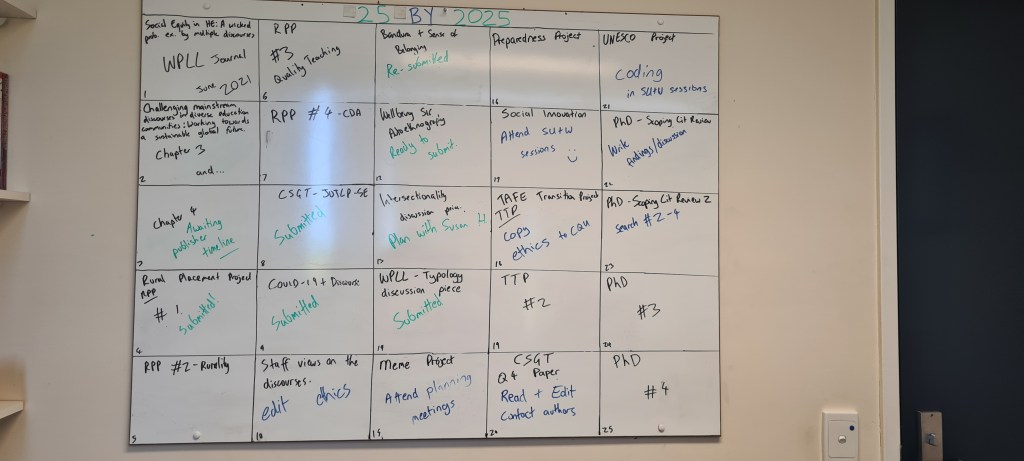
My Whiteboard – May 2022 I want to have 25 publications by the end of 2025
Above is the whiteboard in my office displaying the 25 publications I have planned. I want to have 25 by the end of 2025. So let’s start at the top left and go down each column.
The first three are publications I have already had published or accepted. This first is a discussion piece which came out of my honours thesis, co-written with a former colleague at my previous university (FedUni, where I was emplyed sessionally). Dr. Susan Emmett who is a wonderful mentor and never ceases to encourage me. The article is about social equity discourses in higher education and can be accessed here.
The next two are chapters in an edited book which have been accepted but we are waiting to hear the offical publication date from Springer. One is co-wrtten with Susan about the same social equity discourses but it also discusses the pandemic. The other is a scoping literature review which looks at deficit discourses in higher education and it is co-written with another academic from my former university. That’s 3 down and 22 to go!
The next four sections are labelled RPP (Rural Placement Project). This is a project where we initially interviewed Pre-Service Teachers that had done a rural placement. So it’s all about the teacher shortage in rural areas and the governement incentives for teachers to work in rural areas. Dr. Tim Fish from Monash university invited me to join this project as we share a passion for rural education. We are a team of four with Ondine Bradbury from Deakin University and Richard O’Donovan, also from Monash. That is the main team but we have had a Research Assistant (RA) do some of the work as well and they are listed as an author. I am by far the least experienced one on the team, but they never treat me like that. As you can see from the whiteboard we have 4 publications planned and the first one has already been submitted. The team meets fortnightly.
Next is “CSGT-JUTLP-SE” which stands for Cross-School grant team, Journal of university teaching and learning practice, special edition. I put together a team at FedUni because they offered an internal grant for research teams that had people from Arts, Education and Business. We sent our article in to the JUTLP special edition and they suggested we combine our work with Michelle Joubert from South Africa. So we did! Can anyone say “gee an international collaboration will look good on your resume”?! It is currently “under review.”
So is the COVID discourse article. It is an extension of the first article and the book chapter. Also co-written with Sue Emmett. Submitted to a Q1 (top ranked) journal, waiting for it to be reviewed.
The bottom tile in the second column is a project that I am determined to keep as a solo project; my only one! I want to survey and then email interview enabling staff about their views on equity and see how their views align (or not) with the 4 discourses that Sue and I have created.
The Bandura and Sense of Belonging article is another discussion peice. There was some drama with co-authors but it ended up being Trixie James and I that submitted it. It is also the JUTLP, but a different special issue. We got it back with major revisions, completed those and re-submitted it. Should hear any day now.
The next project same out of a Wellbeing Special Interest Group (SIG) which is part of the National Association of Enabling Educators, Australia. A group of us got together to write reflecitons and then do an autoethnography of our experience during the pandemic. It is almost ready to be submitted, my parts are done.
The next article is a discussion peice on intersectionality which I will write with Dr. Susan Hopkins later this year. She is part of the Wellbeing SIG project and was quite keen to work with me on this one after I sent her the draft I had written. She wants to make the article more theoretical and I am A-OK with that. Plan to submit it before the end of the year.
The next article is co-written with Sue Emmett and it is a follow up from our first article. It names the discourses we discuss as a typology and argues for their usefulness. I’m not sure that it will be accepted but it has been submitted so we will see!
Katrina Johnson, Cody McCormack from my unversity, and I are putting together a project to examine how students interact with memes about student life. They tend to line up with what the research says students struggle with, and personally I can identify with quite a few of them. I want to know if I am alone in this! So this is another project which was certainly my iniative however Katrina has far more experience than me. Still in the planning stages.
The preparedness project is with Michelle from South Africa, my dean Karen Seary and probably another couple of co-workers. We have had one quick meeting with Michelle and determined that we are all interested in doing a mixed methods comparitive project around student preparedness. Next meeting and finalising who is on the team should happen over the next few weeks. Karen is a busy lady!
My university has a social innovation group and we are writing a discussion piece which defines social innovation and shows what that looks like in enabling education. It is all being done during weekly Shut-Up and Write sessions.
The TAFE transition project is with Sue Emmett and Talia Barrett from FedUni. We are looking at how they transition to unversity as they enter second year after coming from TAFE. This group of students has one of the highest attrition rates. We have ethics approval from FedUni and now I have to get it done for CQU. We are planning at least 2 publications.
The bottom tile in the fourth column is the second publication from the Cross-School Grant Team but this time it’s not a collaboration with MIchelle in South Africa. It focuses on one qualitative question about what concerns students had during the pandemic and the emergency move to online learning. I’ve used a sense of belonging framework which I think will work well. The discussion section is still not quite written properly.
Next! Last column. The UNESCO project is a big report which came out in 2021. Sue Emmett and I are going to code it according to our typology of social equity discourses. So far it seems to be very much transformative and social justice related. It has also directly opposed neoliberalism on a couple of occasions. You can find the report here.
The last 4 tiles are for my PhD which I hope to do via publication. That is a least a whole separate post, if not 10.
So that is it as far as my current research goes! Multiple projects, at different stages, loads of fun!
-
Subscribe
Subscribed
Have a WordPress.com account? Log in now.

