-
Overdue update
I have been playing around with Microsoft Designer lately. Below is an image I got it to create of myself… I’m not sure that my face is quite that round but I like it!

I also used Microsoft Designer to create an image promoting a webinar that I did with the Mental Health and Wellbeing Special Interest Group (SIG). I probably should have written about this webinar BEFORE it happened – oopsy! Anyway the promotional email included this image:
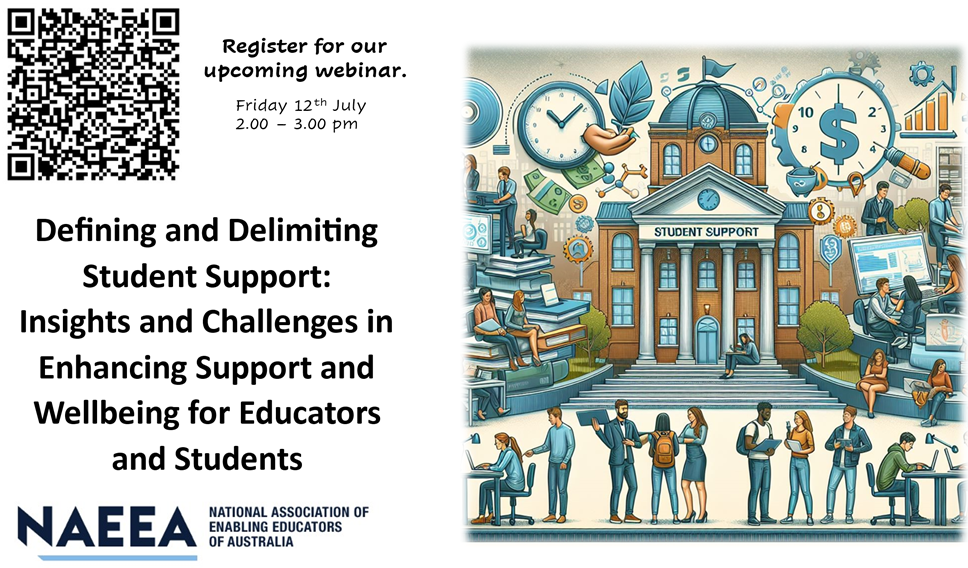
The webinar went really well and we have 40 people there which felt like a lot at the time. It was promoted through NAEEA – so you know, a national organization and it is a great thing to have on my resume. The same team had a presentation at the STARS Conference although sadly I couldn’t attend myself.
I AM going to Darwin in December for the NAEEA national conference… and here’s THAT image/website: https://agentur.eventsair.com/naeeaconference2024/
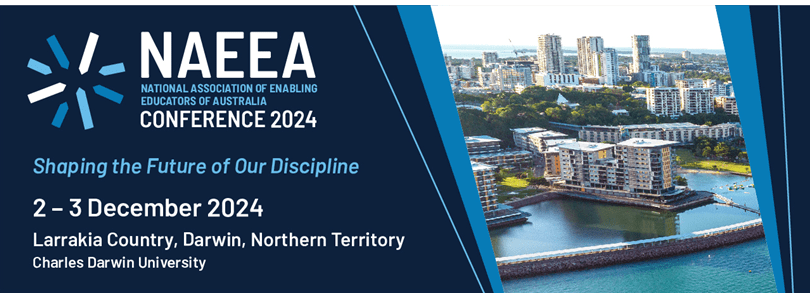
So I have 6 abstracts going in for that conference. That is one for the Self-Efficacy SIG that I facilitate as they have asked each SIG to have a poster promoting the SIG. Then there is two research projects, one for the Self-efficacy SIG and one for the Mental Health and Wellbeing SIG that I am part of. We intend to also submit articles to the special issue of the Journal of University Teaching and Learning Practice that is associated with the conference. So that’s two projects, two conference presentations and possibly two articles to go with them.
The next abstract I’ve submitted is again one that they requested because I received a small grant from NAEEA in 2022. I have not actually finished collecting data for that one yet, but I have 8 completed interviews so that was enough to know broadly what findings I am going to present at the conference.
The final two abstracts I have submitted to the conference are related to my PhD. I figured I have done a pilot study with 3 students, I can present those findings as a case study. The second one is a shorter presentation about the trauma that they shared with me, how important self-care and self-reflection is when doing qualitative work and I’ll touch on the ethical considerations as well. Sadly my supervisors were unable to assist in any way with the conceptualization, writing, proofreading or editing of those abstracts as I am still officially on leave from study. I did send the first 250 word abstract to them but, as I mentioned, they were unable to look at them. As they had not contributed I removed both supervisors as authors. I had previously listed them because naturally they have supported me in the process leading up to collecting data from the 3 students I am presenting about. And you know, they’ve been a part of everything PhD related so I figured authorship was appropriate.
The personal problems I have been dealing with are still there, but like most emotional things they are dying down as time goes on. I’ve been talking to friends and colleagues about it all and that has helped a lot too. I am still feeling anxious, like physically anxious when I think about going back to full time PhD study in October. When I reflect on that I realize it’s because I only have so much energy – generally speaking – but I’m most worried about emotional energy at the moment. More worried about the emotional energy than I would have been in the past. And the truth is that I believe my PhD takes more emotional energy than anything else.
That is not because I am not motivated. It’s not that I procrastinate. It’s because I spend a lot of energy on managing my supervisor relationships. By now I should probably know what to expect from them but that doesn’t really help when I think about how much energy I spend on it. At this point I know I still have a couple of months to decide. I WANT to go back to full time study so that I can continue to receive the stipend payments but I know that is probably not what’s best for my emotional energy or my mental health. It is a decision that I am putting off.
-
It hit the fan!

I consider myself a professional. Today I really didn’t feel like being around people at all but I delivered a class that I think was exceptionally good. It was on paraphrasing and I started with a brief summary of the paraphrasing techniques that were discussed in the lecture. Then I asked students to paraphrase 2 long and academic sounding sentences. It would have been tough! I know that most of them had to Google the meaning of multiple words. There was a percentage of the class that didn’t get past the first hurdle; understanding what they were reading. I gave them almost 10 minutes to paraphrase around 40 words. Most did not get it finished and that was my point.
From there we talked about the skills needed to paraphrase, and the importance of knowing where you are at in relation to those skills, so that you can accurately plan out the time you need for an assessment. We also looked at Turnitin and talked about those skills in terms of plagiarism. It’s all sounding lame as I write it but you have to believe me when I say that I got my on campus class of 13 students really engaged in a discussion on paraphrasing! I am a professional! Because what I was feeling and what I wanted to do was go home, curl up and have a cry and then a nap.
I wont share too much in this medium I will just say that my personal life is a bit of a mess at the moment. I was on track doing full time PhD and part time work. I was keeping up, at least for a couple of months. But now that things have hit the fan I know that something had to go. I can’t do it all. So I have taken a 6 month leave from study and put my PhD (and the stipend) on hold. That will hopefully allow me the space and time to continue being a professional, put the energy into my students and my personal life and hopefully not drop too many of the other balls that I currently juggle.
In other news the article the Wellbeing SIG had published was mentioned in a Student Success symposium the other day and has also featured in the blog the Sally Kift edits! You can see it here: https://needednowlt.substack.com/p/unlocking-success-the-interdependence
-
Mixed update
I laughed at the title I just wrote – Mixed Update! Hahaha everything seems very mixed at the moment! Everything I tell you!
I spent $200 to buy a better coffee machine for the staff room and no one uses it. That probably explains why no one has said thank-you.
Recruitment has officially started for my PhD. I sent a proper newspaper style “advertisement” to go in the student newsletter. But between last year and now the newsletter has become a news website. I can just imagine that all students check that regularly – NOT! And the nice article I sent became one line without the QR code… and that one line invite is about 7th down the page. I’m really not surprised at all that I have not got one single response.
I’ve also been in a fairly large amount of pain in my hip and knee because my pelvis is out of alignment at the moment and that is making me kind of miserable – impacing my sleep and ability to concentrate etc.
So that is all the moans and whines I think!
It looks like the NAEEA Mental Health and Wellbeing SIG I’m a part of is going to go for a grant next year – based on the autoethnography project that I am leading. So that is pretty exciting. We might even have someone else join us (email pitch is going out soon) but I wont say who unless they say yes 🙂
I did have over 300 comments on my literature review and introduction chapter but now I have only 189 left. I was hoping to get that to 150 (ie half) by the PhD meeting I have this Wednesday but that is not likely. Most of them were fairly repetitive. I needed to go into more depth, or perhaps I should say I needed to unpack things more. I need to use more international sources then narrow down to Australian and finally down to Enabling Programs if I can. It all made sense to me. I guess I would summarize it by saying that I needed to lift the whole thing up a notch. There is also a lack of clarity because I’m trying to pack too many ideas (well too many nouns) into each sentence at times. My supervisors aren’t following my train of thought because it’s not clear enough. I mean they would never say that in their comments because that might show weakness and mess up the power dynamics. But it’s clear from their comments, and from my writing that that is what is going on.
It’s also been amusing to see their self-efficacy in action. Both supervisors offer significantly more comments on the sections that are within their areas of expertise. I guess that wasn’t unexpected exactly, it was just a weird thing to observe. It was even weirder when one supervisor acknowledged that! I laughed and I didn’t know what to say. In the end I think I made a comment about “well that’s why I choose this supervision team” or something to that effect. Anyway, I do have all the bases covered as far as supervisors being all over the content, at least I do at this point.
In other good news the Self-Efficacy SIG autoethnography project is swimming along nicely. I have a couple of tasks to do for that one, but nothing urgent or stressful so that is a win.
I don’t have any other projects at the moment and I am struggling a little bit with that but it is forcing me to work on my PhD, even when I’m in pain and I don’t really feel like it. Overall I am ahead on the writing timeline by 3 weeks. I have that same 3 week to finish off the 189 comments I mentioned before and judging on how that has been going so far I think that is easily achievable. So writing and editing timeline is looking A-OK. It’s just the recruitment which I’m worried about.
This is week 2 of term and so far teaching and the Academic Learning Centre (ALC) stuff is all going smoothly. I was just checking how to pronounce one student’s name prior to doing this update. I’ve got some short samples of student writing to look over but I’m otherwise on top of everything. I have to prepare a powerpoint for next week’s ALC workshop and I’ll update my Essay Writing powerpoint for class this Thursday. It’s a short to-do list really. Marking will change the relaxed nature of it all! But I have a couple of weeks yet.
Well I guess that’s all folks. Mixed report card – some areas with no worries and some frustrations as well. Life must be normal or something!
-
Term 1 Orientation
Today is the main day for STEPS students Orientation for Term 1 here at CQUniversity. Orientation always makes me reflect on my own journey and it’s good because I have come a long way from when I first stepped foot on the Gippsland Campus of Monash University. Long way! But the journey has been hard and I typically share some of that with my students. Between then and now I have been married (twice actually!) and divorced (just the once – I got it right the second time). I lost my dad suddenly and my mum to cancer. I’ve dealt with being a type 1 diabetic every day and I have not worked full time in that 14 years (my bank account can confirm this!).
Having said that I have received only 3 Credits and every other grade was a Distinction or a High Distinction. I have completed an undergraduate and Honours degree. I’ve started a new business (teaching rock and roll dancing) and I’ve got 8 publications while doing a PhD part time. That PhD is not finished yet and so I’ve reflecting on these achievements because things are just about to get tough.
I’ve almost finished a rough draft of the literature reivew and my writing is fairly clear but it’s not great. It’s ok to good. So I KNOW that the comments are going to be brutal and I’m going to need some sterngth not to take them persoanlly and then to act on those comments with humility and the attitude of a lifelong learner.
I’ve got to get back to the students now – although my part for the day is mostly done and it will be Kerry’s gig from here mostly. But I shall enjoy every minute of it. 🙂
-
So far… So… So… something!
My RTP scholarhip/Stipend kicked in on the 8th of January and I have been working on my PhD full-time since then. I WOULD say so far so good but that is not 100% correct. I should admit right now that I am not 100% clear on what goes in what section of my PhD thesis. I’ve put some stuff about Social Cognitive Theory as my framework in the introduction but I know it is going to do throughout. I’m nto exactly sure what I then need to put in the literature review. Plus I KNOW that I’ll put things in the literature review that should go in the discussion and visa versa. Helpfully Anna (principle supervisor) gave me a dot point “list” of the chatpers of a standard thesis and what goes where. It was very useful but not detailed enough. I know every thesis is different, so I understand why it wasn’t very detailed. Anyway I should have probably just said that I know absolutley nothing about how to write or structure a thesis this big – I guess until you do it, no one does!
I’ve got a timeline and chunks of the thesis to write. I am keeping up with those very well so far – but I’ve only just got feedback back on the first chunks. Anyway the churn out words – that part is going well. I’ve been taking my confirmation report and adding in more details, few more sub-headings etc. Perhaps I should just stick to this – write, write write and then edit when I get my comments back. But I am me – and that wouldn’t be. So I’ve done a couple of things that have landed me in a spot of trouble really!
First I put in an expression of interest for a RHD spot on the Research Board for Federation University. So that’s where my PhD is, not where I work. But I let my supervisor at work know – I guess that was my first mistake. It didn’t go down well because I have had to withdraw from a number of research projects, including one with the Associate Dean (who I absolutley LOVE). Anyway, I can see from a personal level how that was quite rude of me. Withdraw from her research project and then take on something else instead. I would apologise but she hasn’t spoken to me about it, only through my supervisor. To me that particular part is apples and oranges. I withdrew from an ongoing research project that would take up an unknown amount of hours over a long period of time. I replaced it with a fixed role for one year that involves 4 meetings plus some reading and thinking time. I estimated 20-40 hours over the year. Anyway – that is one part of it. The main consideration for me is that this is something I am chosing to do outside of my 18.13 hours per week of employment. I spoke to our HR equavelent and they agree – it’s my time, not the universities so they really have no grounds to be concerned unless they think it is impacting my job performance – it’s not. So that is one thing that has taken up a bit of my emotional energy lately. The other is a NCSEHE stipend.
I beleive it is brand new because I would have surely noticed it, and applied, if I’d seen it before. They just want to give some money to a PhD or Masters student to help them prepare a journal article manuscript that can be submitted for publication. It’s like their good deed to promote the next generation of researchers in equity. So good on them! But gee I want to apply. A LOT. Of course I need my PhD supervisors to back me and THAT has been the issue. I mis-understood their initial comments and when I got clarification what Anna wants me to do is essentially write a substantial rough draft of the artilce that I’m going to write for the NCSEHE stipend… BEFORE she will back my application for the NCSEHE stipend! As I’m planing to do a Scoping Literature Review you can see how ridiculous that is right?
The money would pay a research assistant to apply inclusion and exclusion criteria to the thousands of search results. But I’m expected to somehow magically do that myself in 3 weeks??? Just so I can apply to get the funding to do that work in the first place. Anyway it’s ridiculous but it’s prompted me to dig my heels in and get stubborn. So I’m going to write the method section and findings with a whole lot of XYZ and X’s where I don’t yet have the data. Then I’m going to write “a substantial draft” of all the rest and see what happens. Hopefully my supervisor will see I can and will find time to do the systematice review and support my stipend application. I beleive I CAN do it for a few reasons:
- The funding is a pretty large motivator!
- We have done a scoping literature review looking at worldwide literature and this one would be systematic zooming in on the Australian literature. So a lot of the planning and thinking has already been done. Ie the research questions are already refined and ready to go.
- The NCSEHE know how long it takes to do a systematic literature review so they are not going to expect a 6 month timeline for the project. I can stretch it out a little bit so that the majority of the hours that I need to put into it will be AFTER I’ve submitted my thesis. I think that shows I understand the nature of research becasue NOTHING ever happens as fast as you think it will!
In other news I’ve done two out of three focus groups for the TAFE project. One was horrible as a participant kept turning the TV on when I wasn’t speaking directly to them. They didn’t mute and the transcript is a mess. The other one got some great data, actually they both have some great data, it’s just buried in one transcript and clear in the other. It was a learning experience that is for sure! Had a good be-brief with Sue and then set clearer expectations in the second focus group which I think helped.
I’m just about to finish off another emial interview for the NAEEA social equity discourses project. I believe that will give me 4 interviews so that is certainly enough for a conference presentation and probably enough for a journal article. There’s a couple of other participants that I hope will also finish their interviews so I am expecting 10 or 11 by the time I’m done. Could be a while though!
Both autoethnography projects are plodding along nicely. No complaints. Progress is slow but it’s there and it’s encouraging. Same with the meme project – about to recruit for the survey this coming term. So no worries there – it’s just the other challenges around my PhD, the stipend application and managing my relationships at work when they are asking about things outside of work! So those are the challenges for me at the moment – keep up with the writing timeline (tick) and then deal with all the other rubbish (half a tick… maybe). Please send patience!
-
Welcome to 2024!
This morning I am reviewing a book chapter for an edited book that feels like it is running about a year behind! We submitted our chapter in March 2023 at which time I volunteered to also review someone else’s chapter. My due date for the review is Jan 31st with authors set to recieve feedback late Febuary. Almost a full year for the peer-review process does seem like a long time – however I know the editors of this book and they are likely to have given some authors a long extension so their chapters could be included.
I am quite on top of things as far as students and the Academic learning Centre workshops go. I made sure of that over the break, even if it was just planning and putting things in my Calendar. It’s not like I have significantly fallen behind in other areas – but the ALC is most certainly the area where I am most ahead.
I’ve done some writing for my PhD – organised some files and most importantly started using Zetero for the in-text references. I have a couple of sections “done” but I will revise them before my PhD meeting next week. What I haven’t done yet is code pilot study data. I have cleaned up the transcripts and read them, written some reflections etc, so I guess that is something!
I have been attempting to start earlier and finish earlier too but so far this has just made me tired. I will stick with it for a couple of weeks and then reassess. Well I’m writing about my daily schedule so it must be time to sign off. The scholarship officially starts Monday so I can breath until then I guess!
Happy New Year!
-
AARE Conference 2023
There is a lot going on right now as we are still in the middle of Term 3. I have workshops with the Academic Learning Centre next week and the week after which I will need to prepare. I’m also trying to wrap up multiple projects including the interviews I’ve been doing for a co-worker, focus group invitations for the TAFE project and some peer-reviews.
I did the pilot focus group for my PhD on Tuesday night. There were many good things and I certainly have some really useful data in the interview. There were some questions I will need to add and some things I will need to improve for the next ones. It was a good learning experience though.
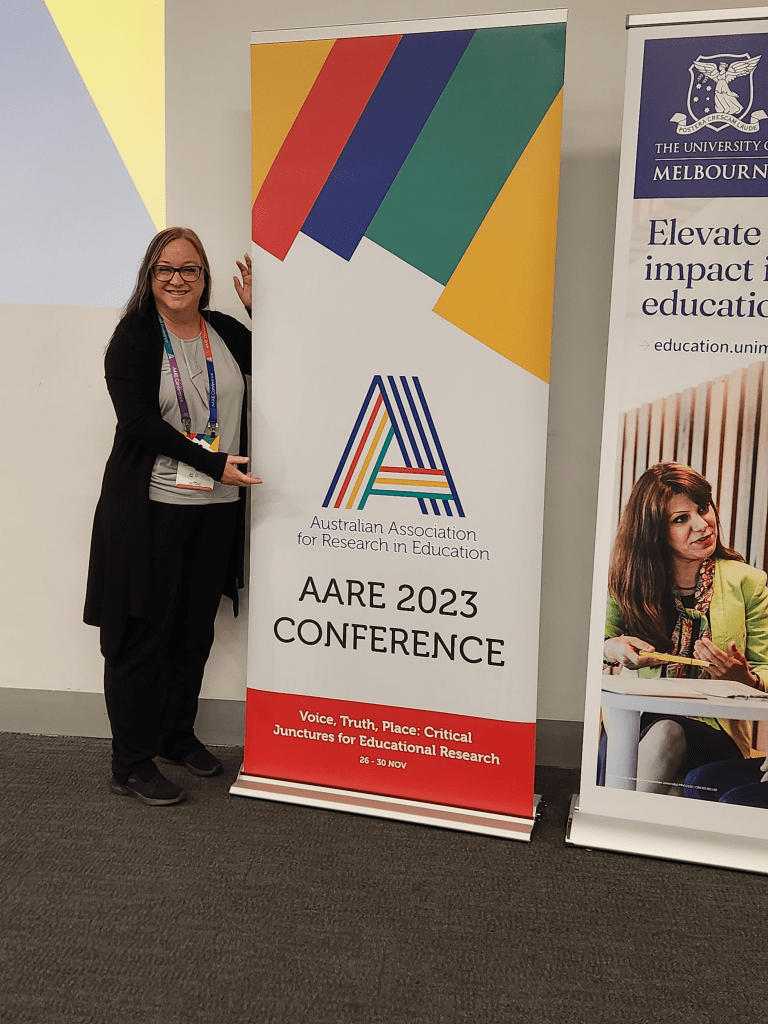
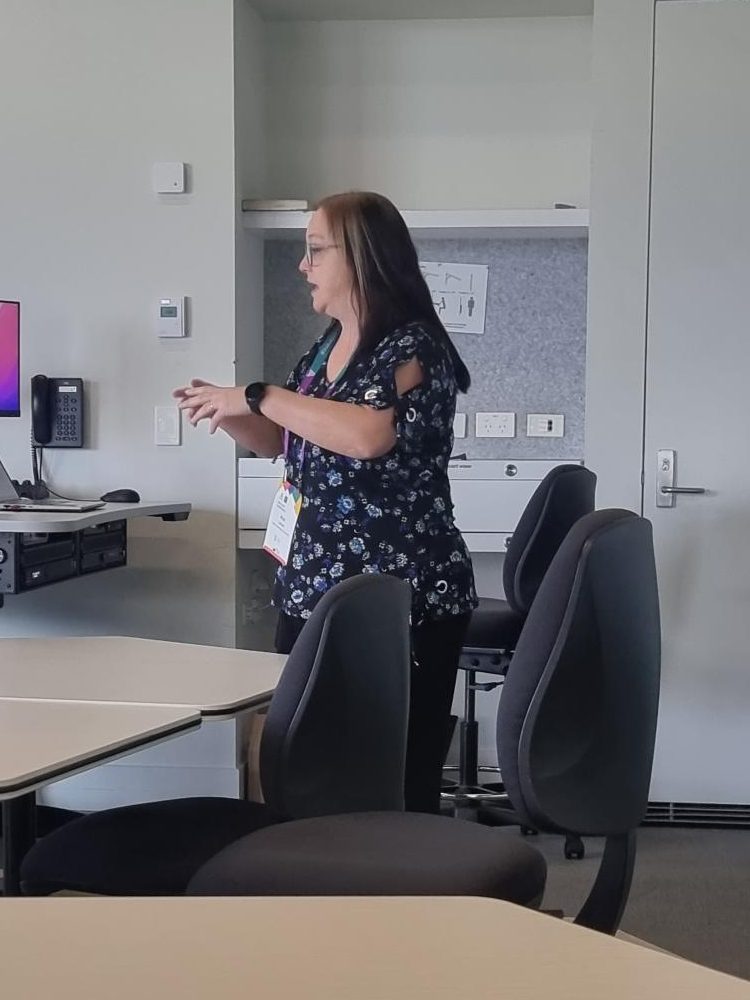
I thought I would quickly share a couple of photos from the AARE conference. This was my second time attending and I was delighted that many of the contacts I had made last year recognised me and approached me for a quick chat. The food was strange but the presentations were excellent. Stewart Riddle was extrordinary as usual and Ellen Larsen was warm and welcoming. One day I hope to be on the executive committee – but not yet! PhD first! I must finish that darn PhD first!
Anyway I did 2 presentations – one on behalf of the Social Innovation working party and one from the book chapter that Trixie and I have submitted on self-efficacy using pre-existing interview data from enabling students. Both presentations had 10 or less people attending but it was still fun and really good practice.
-
Winner! Winner!
Well life is about to be turned up-side-down for me! I will be withdrawing from all the amazing projects which I am a part of unless they are near to completed. I will continue to be the SIG leader for the Self-Efficacy group within NAEEA but I will give up my leadership role in the AARE Social Justice SIG. I no longer have time…. because…

I WON A SCHOLARSHIP!!!
A RTP (Commonwealth Governement) scholarship through FedUni!!!!! But the condition is that I have to be a full-time PhD student. So I have checked the rules and I’m allowed to keep my 0.5 FTE job. I’m going to have my cake and eat it too! I’m going to be paid to work AND paid to study! So, the story from the start!
Well I didn’t really think I had any chance of getting it when I applied. Once before I got a scholarship but that was hardship based because I had to travel to get to a placement (50 ks or there abouts from memory). This one was merit based (which I understood) but I didn’t really know exactly what they were looking for – it was all a bit vague. It was explained to me later that there was 3 equally weighted criteria.
- Past results. I was told my honours results but I think it must have included my undergraduate results as well. I am making that assumption because I got second-class honours (which I think is similar to distinction) but I had a distinction (nearly high distinction) undergraduate average which was more impressive in a Monash Arts degree
- The project. I had to write about how my project linned up with the strategic plan of the university and how it would contrubute to the field of knowledge. My project is about self-efficacy and marginalised student groups – it relates directly to student retention and success. If I couldn’t make it obvious how it was going to benefit the university and the world then there must have been something seriously unclear about what I wrote! So I think this criteria was a strength.
- Research outputs. I had 2 conference presentations, 1 conference poster, 2 book chapters and 4 journal articles when I put the application in. All of these are from “side-projects” and not directly related to my PhD but that didn’t matter. I am certain that there are not many other PhD students with that many research outputs, so I assume this was another strong point in my application.
The irony was not lost on me! The university said rather loudly with this schoalrship that my research outputs were a good thing when my supervisors have been saying that I have too many side projects. Not recently though, they have been happy with my progress. I hope that can continue as I move to full-time in January!
By the way, I DID inform my supervisors I was applying for this scholarship but that was one of those emails which they felt was unimportant and did not require a reply. I am not sure how much of a shock it was to them when they were CC’d into the congratulations email!
Since I got the congratulations email I have been in logic-mode organising my life and how I’m going to fit everything in. I haven’t really had time to stop and just soak it in that out of all the PhD students at the university who applied, they awared this to me. It is by far a career highlight – my biggest thus far – and it will be hard to beat in the future. I am feeling extrememly happy, a little bit daunted or scared, but mostly I just want to get on with it. I don’t want to waste this win as a motivating factor.
-
The other half!
So last time I wrote an update on the status of most of my projects but not my PhD because there have been some ethical issues. I have had plenty of time to reflect on those so I am going to attempt to speak about it.
My PhD is going to have participants from the university where I study (FedUni) and the university where I work (CQUniversity). I think the ability to compare the data is very important, especially in the field of enabling education where there are some single-institute papers but not a lot ot multi-institution stuff done. Initially I wanted to involve as many universities as possible but that was squashed by the confirmation panel. I hope to have the willpower and the energy to gather data from other universities after my PhD is done.
At CQUniversity they are going to provide me with a list of students names and email addresses for all the students that fit my requirements – that is they have finished the enabling program within the last 2 years and have entered (or are about to enter) into undergraduate study. I will then send the email invitation to those students from my CQU email address. I have no direct connection to those students or power over their grades, although there is still a power imbalance just because I am a lecturer and they are students. I didn’t see an issue with this at all.
The procedure for FedUni was going to be very similar except the Student Communications team was going to get the list, send the emails and let me know how many eligilble students recieved the invite. Again, no problems that I saw. I cannot stress this enough…
I HAVE ETHICS APPROVAL FROM THE COMMITTEES AT BOTH UNIVERSITIES TO DO THAT as my recruitment method. Both universities. Both approved. The TAFE project with Sue was similar in that we wanted the students that had done VET course and then used it to enter university. What felt like “all of a sudden” we were not allowed to have access to the list of those students. That would not provide it to us, Student Comms, The Pope, no one! At first Sue and I did not understand why.
It is a privacy issue because those students have not explicitly stated that their email address (which is their personal contact information even if the email address was provided by the university) can be used for research purposes. Most universities (aparently – un-checked information) get around this with a tick-box on the enrollment forms but FedUni does not have that in place. One pretty good analogy would be if a doctors surgery gave us the list of patients that were diabetic – that is an obvious breach of privacy and we came to realise this was too.
So for a few weeks Sue and I spoke to various people to try and have it all explained to us. It just seemed outrageous (at the time) that we had ethics approval for this – so how could they stop us on ethical grounds? I guess it was hard to see past that at first. In the end we spoke to an amazing woman right at the top of the ethics food-chain at FedUni and she gave us the doctor-patient analogy – then we got it! So we asked a few questions about what changed and talked about other details such as the fact that the ethics committee obviously wasn’t aware of this or they would not have approved our project!
My next challenge was communicating all of this to my supervisors. Remember that they had repeatedly told me they were giving me too much of their time and I felt quite hesitant to bother them with anything. They were very dismissive of the issue when I raised it. They kept reassuring me that as long as it all went through Student Comms it would be fine. I was told to trust the system. I was told flat out that it was a “non-issue”. In this case, as the powerless student, I did know better, so I was persistant. In the end I had to go over my supervisors heads and get the amazing lady from the top of the ethics food-chain to speak to my supervisors.
They then attempted to sell me the “it’s not a big deal we will just change the recruitment method” story. I openly complained about a lack of communication as after they’d spoken to the ethics lady they had not communicated anything to me. I did not know if I needed to do an ammendment for ethics (as my recruitment method was changing) and I thought there was a possibility I might have to re-do confirmation of candidature as it could have been considered a significant change in my project. Anyway, at the time it was quite stressful and I did feel very powerless and unheard.
There is plenty more to reflect on. For example, I haven’t seen the enrollment forms at CQU so I am only assuming that students do give their permission for us to use their email addresses for reserach invitations. I am certain that I do not want to be the person who exposes a privacy issue within the university if there is one (which I doubt, but it is a small possibility). There is a whole lot of power relations going on there so with that in mind I’ve chosen the “trust the system” and just keep quiet approach. I’m sure there are others in similar postions elsewhere.
The end result for me is that one university is going to allow me to contact the specific students I need via email and the other will have a different recruitment method where I will essentially put an add in the student newsletter. It’s not ideal but my supervisors are happy and so I (once again, and here you’ll also note that power differential) am just doing what I am told!
-
Half an update!
It has been a while so I’m just going to attempt to write an update on anything and everything! Perhaps one journal article at a time! The hard part is I can’t remember what I have written previously and what I haven’t! Apologies if there is repetetion!
- The typology discussion piece and the autoethnography on change fatigue are still in press officially.
- The covid article, social innovation discussion piece, the study on staffing rural schools and the one about student concerns during COVID were all rejected. Each one is at a different stage now but there’s plans to resubmit each one.
- My solo project on staff views of social equity discourses is going ok – I have a couple of emails to send but so far I’ve enjoyed the email interview process.
- The meme project is nearly ready for ethics ammendments to be submitted.
- We haven’t really heard anything from either of the edited book! Just a waiting game there.
- The Wellbeing SIg AND the Self-Efficacy SIG’s are BOTH about to start autoethnography projects – I’m leading them both and so far so good.
- The UNESCO project is moving along slowly but the TAFE project has stalled. Issue with accessing the list of students that have come from TAFE to unversity.
I actually don’t have time to get into that giant ethical issue right now – but I will say it has resulted in me having to come up with a new recruitment method for my PhD. Which of course means ethics ammendments and the whole works. I’ve got to run – at least that was half an update!
-
Subscribe
Subscribed
Have a WordPress.com account? Log in now.

