-
General update – study and research
I have been making good decisions lately. I have said no to a number of opportunities that I would REALLY like to take. I have however updated the word document I have listing all the things I want to do and write in the 5 years after my PhD is done. I only have that 5-year window when I am officially an Early Career Reseracher (ECR) and I intend to take full advantage of it.
An article finally came out from the internal grant we got way back in 2019 while I was still at Federation University. It took us a very long time to finish it because we got distracted by a collaboration on the same project with Michelle from South Africa. So the data and findings from the project have been combined with other data and then published. But we hadn’t published just our main findings. Now we have. The article is called “Student belonging during COVID-19 emergency remote learning: A case study from an Australian regional university” and it can be found here: https://ajal.net.au/downloads/student-belonging-during-covid-19-emergency-remote-learning-a-case-study-from-an-australian-regional-university/
In other news, I submitted two short articles to the Educational Justice Journal after the symposium. Their website is here: https://edjusticeinstitute.com/home/ejj/
The journal is not ranked but they also don’t have a fee to publish and after the symposium I have met the main academics running the journal. I’m not 100% certain of who their main audience is, I suspect mostly Americans but I still think it will be a very relevant audience to my work on equity here in Australia. The first short article I submitted was with Sue about the VET project and the second was from the social equity discourse solo project. That second article, solo project, solo authored. Honestly I wrote it in one afternoon as it was only 3 pages long and it is a project I know backwards.
Anyway, bit of a miracle but the VET project article was accepted with some edits (that we haven’t done yet) but the solo paper – accepted with no edits!! That really doesn’t happen very often right? I was shocked! I thought it was a mistake and emailed the editor back – twice! Hahaha~!
My PhD is ticking along. I am right in the middle of coding. But I’m worried my codes are too big and broad and they are actually topics or maybe even themes. It all made sense when I started – I think I am just second-guessing myself. I will finish it all first THEN show my supervisors and get them to have a look. I’ve used Bandura to make “code buckets” but it’s then the “sub codes” under those that I should focus on.
I should have the coding done by the end of October and themes sorted out in November – ambitious? Probably but that is the goal. Then I will be on leave – working away – but technically on leave from study.
-
Out and about…
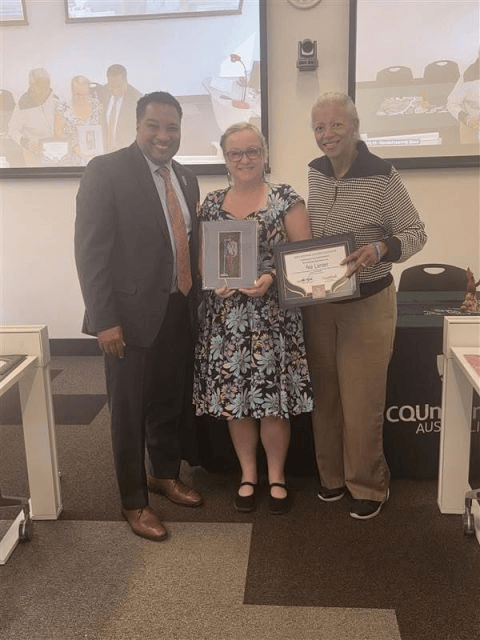
I have indeed been out and about as I travelled to Rockhampton last week for the Educational Justice Symposium. It was an honour to view the welcome to country and meet a number of academics from America as part of the Educational Justice Institute. It was a small gathering but that made the conversations long, warm and so very valuable. I learnt a lot from the formal proceedings but I learnt even more during conversations over lunch and dinner.
I did three presentations in the end. The first one was around my PhD work: Creating Conditions for Confidence: Equity-Focused Approaches to Fostering Students’ Self-Efficacy.
The second one was about social equity discourses and educator views: Educator Views on Access, Equity and Merit.
The final presentation was The Experience of Marginalised Students Entering University through Vocational Education: The Context, the Pathways and the Lived Experience. This was based on the work that I have been doing with Susan Emmett and in the end I did not use the Powerpoint slides – it became a casual conversation with an audience of about 15.
The main thing that I took home with me was noting how relational the Americans were – they did not talk about pedagogies of care, but it was very clear that their practice centered on relational pedagogies and pastoral care. Overall, it was awesome – just awesome.
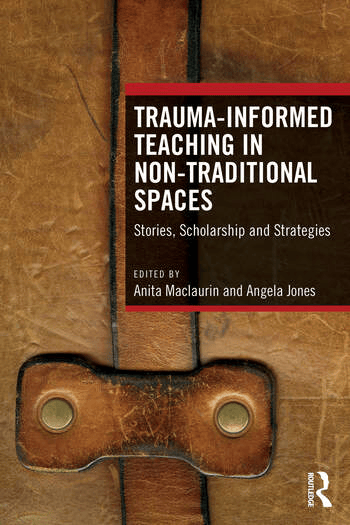
In other news – the Wellbeing SIG from NAEEA has an edited book coming soon! It is now on the Routledge website: https://www.routledge.com/Trauma-Informed-Teaching-in-Non-Traditional-Spaces-Stories-Scholarship-and-Strategies/Maclaurin-Jones/p/book/9781041313441
Gemma and I were section editors and had chapters of our own as well. The team was just amazing, inspiring and overall excellent – led by Anita Maclaurin and Angela Jones – legends!
There is a lot of other things going on at the moment but I will leave it there for now and “attempt” to write again soon.
-
Student Success Conference
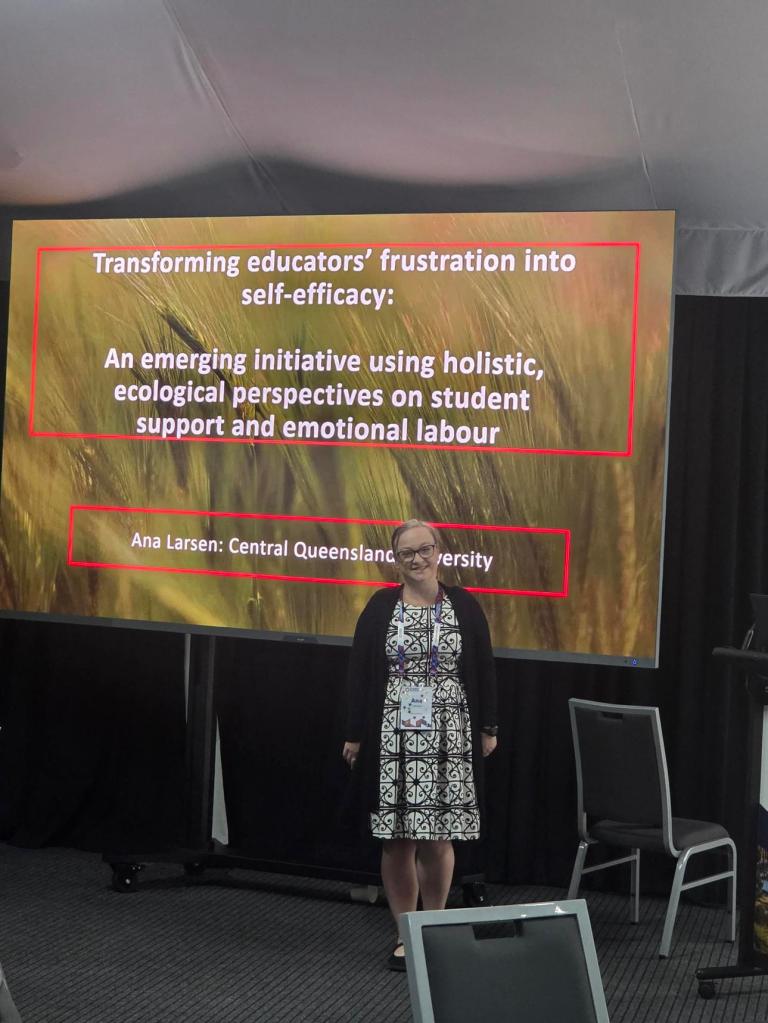
I had an absolutely wonderful time at the Student Success conference. I probably should be making a LInkedIn post rather than a blog post but I don’t care – eventually I’ll do both. This first photo is me about to start my second presentation – I had over 20 people in the room and it was the last concurrent session on the last day so I was very happy with that.
I learnt a lot over the conference but that is normal – every conference hurts my brain with too much information. I went to one session just purely out of personal interest – knowing that it wasn’t going to relate to my reserach or teaching role much at all. I should do a little more of that at future conferences. This one was about data and not leaping to conclusions. They found 60-something students had swapped and changed their subject choices before census date. They originally THOUGHT it was a problem with the enrolment system and that students were confused etc. After speaking to the students they realised they were very intentional about all the subject swapping around they did – trying to create their optimal timetable, examing the assessment tasks in detail and so on. Very strategic students indeed!
It was also lovely to see “my people” in person including Karen Search, Trixie James and Anne Braund to name a few. Sarah O’Shea was there and I had a WONDERFUL conversation with Sally Kift too. Onur form Maquarie was there too and lovely to catch up with him. We had some laughs that is for sure!

This photo is me with the poster I did with Amy Claughton. I had a few people come and chat to me about it. The main thing I took from those conversations is that people agree that trauma informed practices can easily be put into the “that’s too hard” category and then educators shy away from it. I was greatly encouraged that my work in this area will be valuable long term.
That’s all for now – if you hear me mention the conference again just know that I had a great time 🙂
-
How’s my to-do list?
You know I started this post feeling a little overwhelmed – which doesn’t happen often for me. But I’ve come back and added this line it to say that now it doesn’t seem so bad and the stuff I have DONE feels like it outweighs the to-do after all
It HAS been a busy time. I am preparing for the Student Success Conference which is not that far away. I have a poster that needs to be done by the 1st of next month and two Powerpoints to plan and create as well. Then I have NAEEA 2026 conference abstracts to submit. I have done two so far but I need to do at least one more and help on the team with some others.
Now that Amy is my PhD supervisor she’s giving me a to-do list there as well. Nothing too crazy but I’m feeling different about it. I have to write a 1-pager that covers my project methods etc.
The of course to top it off marking “round two of three” has hit. The second assessment is basically an essay plan and it is the one that takes the longest to mark. I realised the other day that term 1 last year I was only 0.5 (2.5 days per week) and now I am 0.8 FTE (4 days per week). No wonder I’ve got more students and I feel a whole lot busier! I’m so thankful that I’m working with a really wonderful Unit Coordinator and, well the whole team really is pretty jolly excellent.
Finally, some good news. The chapter that Trixie and I wrote in ummm 2021? MAYBE 2022 has FINALLY come out! Here are the details 🙂
Larsen, A., & James, T. (2026). Empowering Australian Enabling Students: The Importance of Building Self-Efficacy. In M. Cacciattolo & J. Burke (Eds.), Exploring Equity, Inclusion and Agency in Education (pp. 135–153). Springer Nature Singapore. https://doi.org/10.1007/978-981-95-6382-1_8
-
Here we go again… new supervisor
When I started my PhD a lovely, warm, wise lady named Margaret was my supervisor, with Stuart as the associate supervisor. Stuart has been a constant the whole way through and that has been very valuable – but no one is perfect and he isn’t either. Margaret was replaced by Anna who really knew her stuff but wasn’t the warmest person. Still that Anna/Stuart team could have got me through it. Then Anna very sadly was unwell and then replaced by Nici.
Nici was absolutley amazing. She was practically perfect in every way. Unfortunatley she saw the worst parts of the university and the toxic culture meant she lasted less than 2 years. She’s moved on now and I am AGAIN in need of a new principle supervisor.
I had a list of possibiliities, even from a small university where there wasn’t that many options. My friend and co-author Sue Emmett was one posibility but she is just about to go on 9 months long service leave. That meant she really wasn’t a good choice.
I have however ended up with what I think is a really good choice and that is Amy Claughton. She is warm, kind and caring but I have no doubt she can kick my butt when that is needed too. I will be her first completion as principle I think so that is an honour. She was a little hesitant because she’s only just qualified to be principle but I have no doubts about her at all.
Our first meeting is next Thursday and I can’t wait!
In other news… the book chapter with Trixie is STILL not out yet. It was March, then April and now May. I have edits to do on an article with Sue Emmett. That is from the project where we talked to students transitioning from Vocational Training into university. We are working on edits for one article AND a conference submission at the same time… and trying to get the second article done before Sue goes on long service leave! Fun stuff!
The grant project is stalled at the moment. I need to find out about the funding. We have a research assisstant lined up and one focus group has been done. The book project with the Wellbeing SIG is coming along too. I’ve done the peer-reviews for my section and got revised versions of the chapters (4 in my section). Next I need to write an introduciton to the section and an “outro” which is essentially a summary including practical applications. It shouldn’t take me long but it FEELS like a complex task because the 4 chapters cover a LOT.
I have booked accommodation and paid registration for the Student Success conference AND NAEEA at the end of the year. For SS I had 4 submissions, 3 emerging initiaitives (short presentations) and a poster. The poster and the solo presentation were accepted with no edits. The one with Sue was accepted with edits and one was rejected (the meme project). Overall, I’d say 50% with no edits and 75% accepted is a jolly good rate. I’m happy anyway.
I will write again soon about some of the stuff I am diong in my classroom starting this term around self-efficacy. For now, I have to get back to marking – I’m almost done!
-
PhD progress +
How is it almost April already? I have no idea!
I had some realization early in the year that my procrastination around my PhD was more about the emotional labour than anything else. There is a small slice of doubt, of course! Will I have enough data? Will it be good enough? What happens if I analyse it and there is nothing NEW to say?
So is there a bit of insecurity or imposter syndrome inside me somewhere? Sure! But THAT, well that is not the big thing that has been blocking me. It is the fact that my participants are students – just as I was and in a way, still are – struggling with the many challenges of study, life, loss etc. I’m not terrible at self-refelction by any means but I also don’t want to have to think about the grief and loss and trauma that I have experieced on my journey. Not if I can get out of it!
The truth is, it’s not doubts about my ability to finish my PhD – it’s doubts about my ability to face the emotional work that needs to be done to survive my PhD. There is a certain level of healing and emotional crap that needs to be dealt with for me to finish my PhD and THAT is what I am unsure about.
So I talked it over with my supervisors. One gets it. One doesn’t. He was “just happy that you have finally had that moment when you doubt everything” Gee thanks. My understanding was that he thinks I am going through the same kind of doubts and fears that every PhD student goes through. Well on some level maybe I am – but again, it’s not fears about the project – it’s fears about the emotional labour OF the project.
We came to a way forward though. I am going to use the data from the 9 students that I have and move forward with that. IF I need to gather more data later – I still can. They are both confident I wont have to. We shall see!
So I’ve been working on the methodolgy chapter, writing about epistemology and ontology stuff. Totally confusing and complicated of course! If only the scientific community had agreed on standard terminology in 1801 then my life now would be so much easier! IYKTYK So you know, THESE struggles are the ones that every PhD student must go through. These are the struggles that I can embrace.
Anywayz…. that first goal for the year about finishing data collection – sort of doesn’t exist anymore because we are running with “what I have already is enough” The DEMTEL article was submitted and so was teh FedUni team one (and rejected – probably not going to be resubmitted) so I have done that goal. I’ve also got both book chapters done, got one back again and acted on the reviewers comments. That was what I’m calling “the trauma chapter” and the comments were very minor.
I am keeping up nicely with my teaching duties – although I haven’t yet sent my students am email this week – but I WILL do that tomorrow. Overall, yes I’m making progress on my goals for the year. Slowly, slowly it’s happening.
I ended up with 4 submissions to the Student Success conference. I’ll have at least that for NAEEA, one is already in and one is almost ready to go as well. I’m just waiting on permission to use my own car to travel to the conferences then I can book accommodation. *yey
-
Happy New Year!
Well a very Happy New Year to everyone!
It was a happy new year to me because the book chapter that Trixie and I wrote back in 2021 is soon to be published – FINALLY! I did the very very final proofreading and signing off yesterday.
I have also finished a draft of the book chapter that NAEEA asked me to write for their edited collection about the current state of the Enabling Education sector. It came together pretty quickly and easily actually because I already had the scoping literature review done – I just had to write it up. I am under the word limit and everything!
The next project that will require my attention is the Wellbeing SIG chapter with Amy and of course the grant project. I will be on leave next week with a friend coming to stay with me but after that it’s go time! That goes for me PhD as well. I have not finished the data collection yet but I will get stuck into that. I hope that I can get the email interviews finished before term 1 starts, for my sake but the students’ too.
So it’s appropriate to set goals for the year – let’s do that!
- Finish the dam data collection on my PhD and jump into data analysis.
- Re-submit the scoping literature review from my PhD
- Finish the solo grant article and submit it
- Sumbit at least one other article – DEMTEL, FedUni grant team, VET project, Meme project, second one on student support or something else!
- Finish both NAEEA book chapters and associated editing work
- Keep up with teaching and ALC duties while all that is going on!
I am confident in completing numbers 4, 5 and 6! Ha ha ha!
-
Just Published!!

https://open-publishing.org/journals/index.php/jutlp/article/view/1515

The Journal of University Teaching and Learning Practice has released our article! This is Amy’s very first publication and it was SO exciting to be part of that process with her. Trixie and I walked her through the thematic coding process and she was so thank-ful for the opportunity to do new things and learn. Such a joy to work with.
This is the first officail project of the Self-Efficacy Special Interest Group (SIG) as part of NAEEA (National Association of Enabling Educators of Australia). Our first project and our first publication – AND it’s a multi-institutional article published in a Q1 journal! Happy happy happy!
Maybe we should have set the bar a little lower to start with! I have a little imposter syndrome being first author on this article as there is so much experience in the group and they all put so much work in. But they needed someone to keep pushing things along, to keep scheduling meetings and checking in with them. THAT part, the whip cracking, that part I did and I WILL take credit for.
So back to the article. CoPilot wrote this summary:
This collaborative autoethnographic study, authored by members of the Self-Efficacy Special Interest Group (SIG), explores how Enabling educators across five Australian universities perceive and cultivate self-efficacy among school-leaver students entering higher education. Drawing on personal reflections and thematic analysis, the study identifies three core areas: educators’ perceptions of student readiness, strategies for fostering self-efficacy, and the barriers that constrain this work. Findings reveal that younger students often present with both overconfidence and low academic self-belief, requiring tailored pedagogies of care, scaffolded mastery experiences, and supportive learning communities. However, educators face challenges including emotional labour, limited time, and institutional constraints. The study calls for greater recognition of this work, professional development, and systemic support to sustain educators’ capacity to build self-efficacy in increasingly diverse and younger Enabling cohorts.
Microsoft Copilot. (2025, November 20). Microsoft. https://copilot.microsoft.com
Good summary! Well at least I liked it. I should have used THAT on my LInkedIn post!
Anyway, I hope someone out there enjoys this article, finds it insightful, useful or encouraging… something!
-
Co-Pilot and I…
Images and a chunk of text in this post has been copied directly from Co-pilot:
Microsoft. (2025). Copilot [Large language model]. https://copilot.microsoft.com/
First I tried to get a summary of ALL my publications but it was a bit off track as I have some “side projects” that were outliers and I think that’s what made it weird. Then I decided to do it in chunks. So the first one I did was the 4 publications that Sue Emmett and I have on social equity discourses. It made a lovely summary and the infographic was pretty cool but full of incorrect spelling so I’ll leave it out.The summary of the 3 articles from the Wellbeing SIG was pretty interesting too – you might have to overlook spelling here as well!!!!
🧭 Overview of the Three Works
Title Focus Methodology Key Themes Larsen et al. (2025)
Student Support, Beyond Empty SignifiersDefining and enacting student support in Enabling programs Collaborative autoethnography – Complexity of student needs
– Institutional frustrations
– Facilitators of effective supportOlds et al. (2023)
Stop the Clocks: Enabling Practitioners and Precarity in Pandemic Time(s)Precarity and time pressures during COVID-19 Collaborative autoethnography – Neoliberal time economy
– Emotional labour
– Workplace precarityJones et al. (2023)
Looking into the “Dark Mirror”Change fatigue and wellbeing of enabling educators during COVID-19 Collaborative autoethnography – Change fatigue
– Technostress and Zoom fatigue
– Emotional labour and wellbeing
🔍 Comparative Insights
1. Shared Context: Enabling Education
All three studies center on educators working in Enabling programs—preparatory pathways for equity students. These educators often serve as frontline support for students facing academic, emotional, and socio-economic challenges.
2. Methodological Unity: Collaborative Autoethnography
Each paper uses collaborative autoethnography to foreground the voices of practitioners. This method allows for rich, reflective, and emotionally honest narratives that challenge institutional silencing and highlight systemic issues.
3. Recurring Themes Across Studies
- Emotional Labour: All three works emphasize the intense emotional demands placed on educators, often unrecognized and unsupported by institutions.
- Neoliberal Constraints: The studies critique the neoliberal university’s emphasis on efficiency, productivity, and economic rationalism, which undermines care-based pedagogies.
- Workload and Time Pressures: Unrealistic workload models and time compression are central concerns, especially during the pandemic.
- Wellbeing and Burnout: Educators report fatigue, guilt, and burnout, often prioritizing student wellbeing at the expense of their own.
🧠 Unique Contributions
Larsen et al. (2025)
- Argues for a clear, consistent definition of student support.
- Identifies three domains: complexities of student needs, frustrations in delivering support, and facilitators of success.
- Advocates for workload recognition and training tailored to emotional and academic support.
Olds et al. (2023)
- Explores how pandemic conditions intensified precarity and disrupted time boundaries.
- Uses Butler’s concept of precarity and Adam’s “machine time” to theorize the emotional toll of neoliberalism.
- Emphasizes solidarity and collective resistance through storytelling.
Jones et al. (2023)
- Introduces “change fatigue” as a superordinate theme.
- Highlights the interdependence of student and staff wellbeing.
- Uses the metaphor of the “dark mirror” to critique the alienating effects of digital surveillance and technostress.
Would you like a visual synthesis (e.g., a thematic map or comparison chart), or a deeper dive into one of the studies for use in your own research or writing?
Absolutely, Ana. Here’s a concise synthesis of the two articles—Olds et al. (2023) and Jones et al. (2023)—which both explore the lived experiences of enabling education practitioners during the COVID-19 pandemic:
🧭 Summary: Practitioner Wellbeing and Precarity in Pandemic Times
🎯 Central Focus
Both articles use collaborative autoethnography to explore how COVID-19 intensified precarity, emotional labour, and burnout among enabling educators—those supporting non-traditional and equity-group students in Australian universities.
🔍 Key Themes Across Both Studies
1. Time Pressure and Neoliberal Workload Models
- Time emerged as the most dominant theme.
- The pandemic accelerated “machine time” and “network time”—terms used to describe the relentless pace and blurred boundaries of academic work.
- Enabling educators faced compressed workloads, unrealistic expectations, and constant availability demands, especially in online environments.
2. Emotional Labour and Moral Injury
- Practitioners were deeply committed to philosophies of care, social justice, and student flourishing.
- The emotional toll of supporting vulnerable students—often without adequate institutional support—led to moral injury, where educators felt unable to meet their own standards of care.
- Emotional labour was intensified by digital surveillance, isolation, and the need to mask personal distress while supporting others.
3. Change Fatigue and Technostress
- The rapid shift to online learning created technological fatigue, especially through videoconferencing (“Zoom fatigue”).
- Practitioners experienced change fatigue—a state of exhaustion from constant adaptation and uncertainty.
- The neoliberal university’s focus on efficiency and output exacerbated these pressures.
4. Gendered and Unequal Impacts
- All participants in Olds et al. were women, many juggling caregiving roles alongside academic responsibilities.
- The pandemic magnified gendered precarity, with female staff disproportionately affected by work-life imbalance and emotional strain.
5. Wellbeing Interdependence
- Jones et al. emphasize the interdependency between student and staff wellbeing.
- The quality of student-practitioner relationships—marked by care, empathy, and presence—was critical to student success, especially in online learning.
- Institutional wellbeing initiatives often felt tokenistic, failing to address systemic causes of burnout.
✨ Methodology
- Both studies used collaborative autoethnography, allowing educators to reflect on their own experiences and collectively analyze patterns.
- Thematic analysis revealed recurring motifs: time, emotional labour, online fatigue, and wellbeing.
💡 Implications
- These articles call for:
- Recognition of enabling educators’ emotional and pedagogical labour.
- Reimagining workload models to reflect the realities of care-based teaching.
- Embedding cultures of compassion and equity across university systems.
- Prioritizing staff wellbeing as integral to student success.
(Microsoft, 2025)
Well that was a morning well spent I think! I learnt some more about using CoPilot and ended up with a nice summary or two.
In other news I have had 1 article accepted recently. It is from an old project that I actually withdrew from a while ago. We were looking at staffing rural schools and how rural placements impacted that. The team did a follow up where they did a content analysis sort of thing on how the universities marketed rural placements to potential students. I really don’t feel like I did a lot on the project – certainly not a lot in the writing up. I did some parts of the literature review and I was certainly there, contributing, at all the meetings and discussions as we conceptualisedand then refined the project. Anyway they were kind enough to include me in the list of authors and it has been accepted into the The Australian Educational Researcher – a well ranked journal. I’m rather happy about that!
The other news is the Journal of University Teaching and Learning Practice but that is a big deal so I think I’m going to create a separate post so it gets the attention it deserves!
-
UniSA Pathways Colloquium
My trip down to the Springfield campus of UniSQ was smooth and uneventful. The hotel was lovely and I was able to stop as see my colleagues at the Bundaberg Campus on the way down too. There was around 50 to 60 people attending the Colloquium in person but more tuned in online for the keynote and panel discussions.
Andrew Harvey did an excellent presentation around access to higher education. It was that big picture sort of policy stuff with a heap of pretty graphs and statistics. I was privileged to have a quick chat with him beforehand.
Then there was the panel discussion and they are always excellent. A man was brave enough to ask a question DURING their parts. I understand why, there was only about 50 people there and the atmosphere was relaxed. Anyway because he did I piped up too. They were talking about community and connection and I asked how to NOT make it tokenistic. I got a great response from Andrew which included ideas around being consistent across the whole process, not rushing, etc. I then, quite bravely, suggested that sounded like it would need “stable, long-term funding”. The chuckles in the crowd and the knowing looks I got from the panel were GOLD. I loved it. A gentlemen approached me later and said “your the women who asked the good questions” – he could only see the back of my head so he wasn’t sure it was me. I laughed!
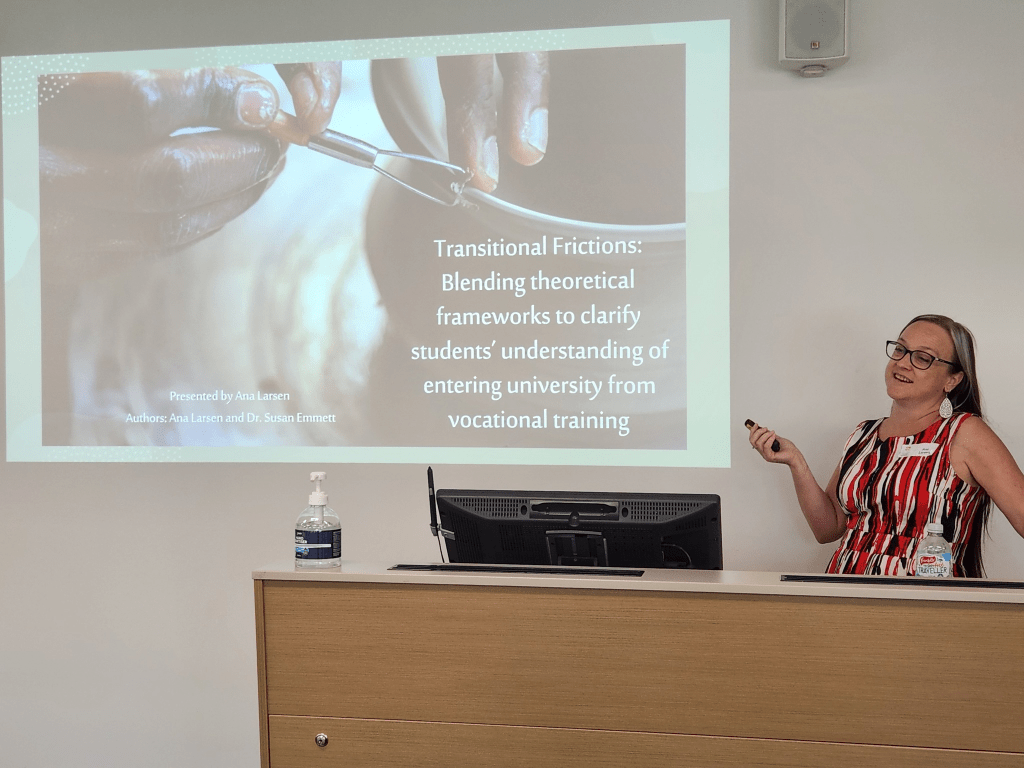
My own presentation was good. I was in a concurrent session with Sarah Hattam so naturally she had the majority of the audience. I was ok with that. It went smoothly.
The other stand out presentation was from Charmaine Davis and Jonathon Green. They were talking about Enabling Education as an emerging discipline. They did a fairly serious literature review AND then also compared the literature in Enabling to Higher Education literature more generally. Not a heap of surprises in their finding but DARN that is going to be a well cited article when it comes out. So useful to have the analysis to back up things we know anecdotally.
I am back to reality now. Marking right before the deadline. Sigh.
-
Subscribe
Subscribed
Have a WordPress.com account? Log in now.

